What to see in Tossa de Mar on foot
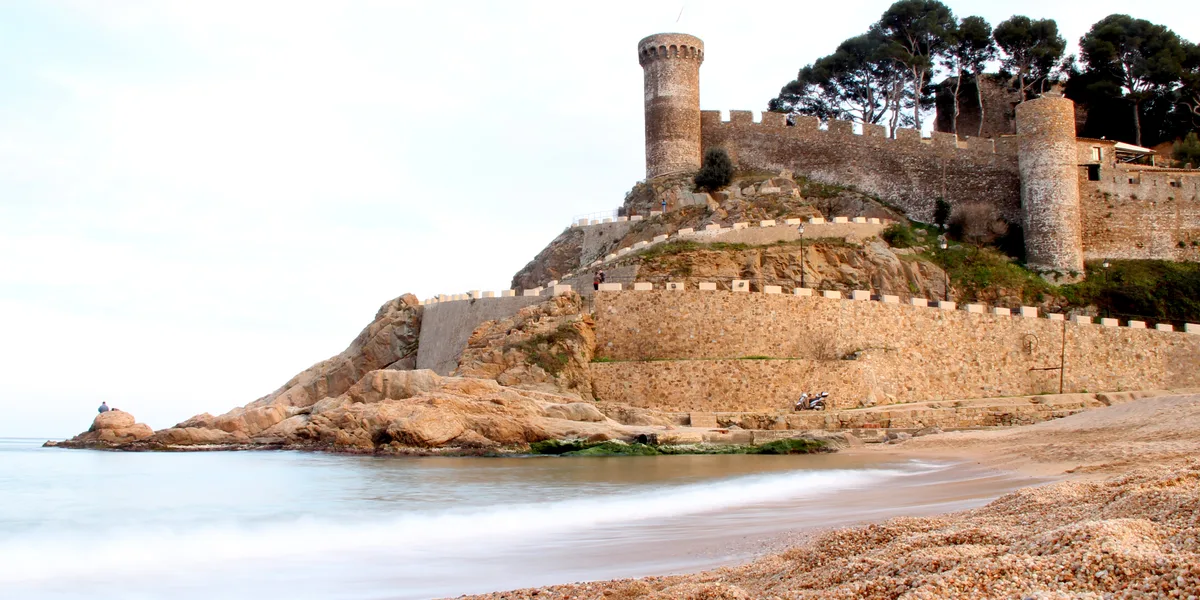
The historic core of Tossa de Mar is the Vila Vella, a twelfth-century walled enclosure that held out against pirates and the French fleet. A 1950 film shoot starring Ava Gardner put the town on the map as a holiday destination, and the remains of a Roman villa have come to light in its fields.
What to see
Vila Vella de Tossa (recinto amurallado)
Tossa's fortified core since the twelfth century: some eighty houses and three towers inside a stone ring that withstood attacks by pirates and the French fleet.
Estatua de Ava Gardner (placeta mirador)
A life-size bronze recalling the 1950 shoot, starring Ava Gardner, through which Tossa became known as a tourist destination.
Far de Tossa — Centre d'Interpretació dels Fars de la Mediterrània
A 1917 lighthouse at the highest point of the Vila Vella, with views in every direction over the bay and the castle ruins just below. It houses the Centre d'Interpretació dels Fars de la Mediterrània.
Platja Gran
Tossa's main beach, where the film Pandora and the Flying Dutchman was shot in 1950. From the water, the medieval wall is seen head-on.
Villa romana dels Ametllers
The remains of a wealthy Roman villa, with baths and mosaics, in use for more than five centuries and found under the field known as dels Ametllers.
Església Vella de Sant Vicenç
The 15th-century Gothic ruins of the Vila Vella's old church, built over an even older Romanesque chapel. It was the town's church before the new one was built.
Iglesia parroquial de Sant Vicenç
A late-18th-century Baroque church that replaced the one in the Vila Vella when Tossa spread outside its walls. Every January it is the setting for the Pelegrí de Tossa, a vow kept for centuries.
Museu Municipal de Tossa (Casa del Governador)
The former governor's residence, with phases from the 15th to the 20th centuries, now the Museu Municipal. Its collection includes an original Chagall.
Platja d'es Codolar
A small cove set aside for fishing boats. Local lore says a fisherman surprised three witches here at midnight and forced them to flee to America for good.
Torre d'en Joanàs
A tower at the tip of the headland that kept watch over the whole bay of Tossa. Today it is the most photographed viewpoint in town.
Torre de les Hores
A clock tower that set the rhythm of daily life and of the guard shifts in the medieval Vila Vella.
Can Ganga — Museu de la Dona
A 16th-century fortified farmhouse with a machicolation, Gothic windows and a larder cut into the rock. Today it is home to the Museu de la Dona.
How much time you need
With the Citourfy audio guide, the walk around Tossa de Mar takes about 1h 13min and covers 3.6 km. If you go inside museums or churches, add the time for each visit.
Getting to the starting point
- Starts right by Estación de autobuses de Tossa de Mar (plaça de les Nacions Sense Estat).
When to go: festivals
Local festivals, in case you want your visit to coincide with one:
- El Pelegrí de Tossa — Festa de Sant Sebastià · January
On 20 and 21 January, one local walks forty kilometres to Santa Coloma de Farners to keep a vow the town made centuries ago after an outbreak of plague.
- Festa Major d'Estiu de Sant Pere · June and July
From 20 June to 1 July, the summer festival, with Sant Pere's Day on 29 June as the main day.
- Festa Major d'Hivern de Sant Vicenç · January
From 22 to 27 January, a whole week of celebrations for the patron saint, with a solemn mass, sardanas and popular theatre.
Tossa de Mar audio guide
The app narrates each place as soon as you arrive, using your phone's GPS:
- Tossa de Mar on foot: Vila Vella, fishermen, and Ava Gardner · 1h 13min · €1.99


Sources
The facts in this guide come from the same records as the audio guide and from these public inventories:
- ca.wikipedia.org/wiki/Castell_de_Tossa_de_Mar
- ca.wikipedia.org/wiki/Llista_de_monuments_de_Tossa_de_Mar
Facts checked on October 22, 2026.