What to see in Girona on foot
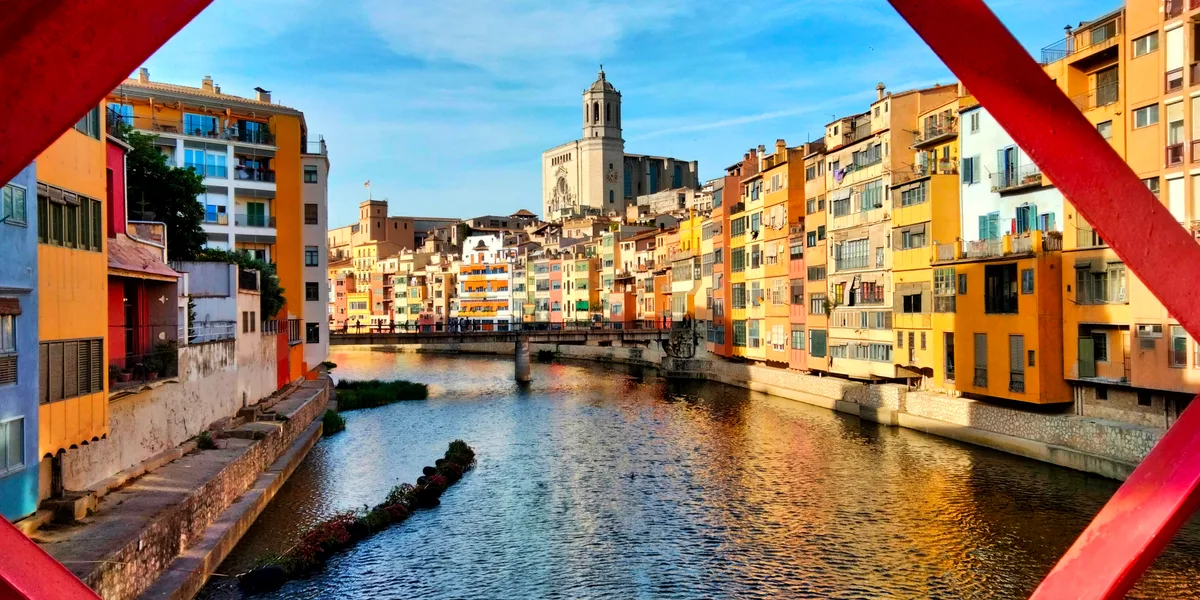
Girona's old town stacks up the Roman city of Gerunda, the Jewish quarter of the Middle Ages and the middle-class city of the 19th century. It is ringed by walls combining Roman stone, Carolingian reinforcements and a Gothic circuit, with the River Onyar flowing below.
What to see
Cases de l'Onyar
19th-century houses overlooking the River Onyar. Their coloured façades are not medieval: they were painted in 1982 as part of a design campaign.
Catedral de Santa Maria de Girona
A cathedral of Romanesque origin, from the 11th-12th centuries, with Gothic and later work up to the 18th. Its nave is 22.98 metres wide, the widest in Gothic architecture anywhere in the world.
Banys Àrabs de Girona
Despite the name, these are Christian, Romanesque baths from the 13th century. A siege destroyed them and they were rebuilt by royal order; their lantern tower has no parallel anywhere on the Iberian Peninsula.
Barri Vell de Girona
The old town packs three eras into some four hundred metres of street: the Gerunda of the Romans, the medieval Jewish quarter and the 19th-century bourgeoisie.
Basílica de Sant Feliu
A basilica known by its bell tower, left truncated by a lightning strike in 1581. It is linked to the legend of a swarm of flies that delivered Girona from a siege.
Monestir de Sant Pere de Galligants
A Benedictine monastery founded in 992, with 12th-century Romanesque architecture. Its cloister stood in for the Citadel of Oldtown in Game of Thrones.
Muralles de Girona
Walls that combine Roman stone, Carolingian reinforcements and a 14th-century Gothic circuit. Today they form the city's longest raised walkway, and the cathedral can be seen from the Torre de Sant Domènec.
Pont de les Peixateries Velles
A late-19th-century iron bridge that locals call Palanques Vermelles. It came out of Gustave Eiffel's workshop twelve years before he put up his tower in Paris.
El Cul de la Lleona
A stone lioness with a popular tradition attached: whoever kisses its backside becomes a gironí, a Girona local, and is said to always end up coming back.
Casa Agullana
A Baroque palace, with work from the 14th to 17th centuries, that spans the Pujada de Sant Domènec with an arch. A family legend featuring a bat is still told about it.
Convent de Sant Domènec
A Gothic and Baroque convent founded in 1253, the fifth Dominican house in Catalonia. Its great single nave was the model for the cathedral's; today it is home to the Faculty of Arts.
Torre Gironella
A medieval tower at the highest point of the wall. In every siege of Girona it was the last bastion to be defended, and in 1391 it sheltered the Jewish community.
How much time you need
Citourfy has 6 walking tours in Girona, 23 min to 30 min each: each area can be done on its own, on different days or on the same one.
Getting to the starting point
- The Call and the Cathedral: Girona on the Rise: Starts a 13-minute walk from Estació de Girona (AVE/Rodalies + autobusos) · AVE, Rodalies R11/RG1, Autobusos.
- Girona in Game of Thrones: Braavos, King's Landing, and Oldtown: Starts a 15-minute walk from Estació de Girona (AVE/Rodalies + autobusos) · AVE, Rodalies R11/RG1, Autobusos.
- The City Walls: from the Passeig Arqueològic to the Torre del Socors: Starts a 17-minute walk from Estació de Girona (AVE/Rodalies + autobusos) · AVE, Rodalies R11/RG1, Autobusos.
- The Onyar, the Rambla, and the Argenteria: Starts a 8-minute walk from Estació de Girona (AVE/Rodalies + autobusos) · AVE, Rodalies R11/RG1, Autobusos.
- From Plaça del Vi to Sant Domènec: Noble Girona: Starts a 11-minute walk from Estació de Girona (AVE/Rodalies + autobusos) · AVE, Rodalies R11/RG1, Autobusos.
- Sant Feliu, Sant Pere, and the Banys: the Romanesque of the Galligants: Starts a 16-minute walk from Estació de Girona (AVE/Rodalies + autobusos) · AVE, Rodalies R11/RG1, Autobusos.
When to go: festivals
Local festivals, in case you want your visit to coincide with one:
- Girona Temps de Flors · May
For nine days in May, more than a hundred courtyards, stairways and corners of the Barri Vell that are usually closed open to the public, decked with floral installations.
- Fires de Sant Narcís · October and November
The patron saint's festival, from 23 October to 1 November: ten days of fairground stalls and correfocs, with 29 October as a local holiday.
- Sant Jordi · April
On 23 April the centre fills with book and rose stalls. It is not a public holiday, so the city keeps its working rhythm.
Girona audio guide
The app narrates each place as soon as you arrive, using your phone's GPS:
- The Call and the Cathedral: Girona on the Rise · 25 min · €0.99
- Girona in Game of Thrones: Braavos, King's Landing, and Oldtown · 24 min · €0.99
- The City Walls: from the Passeig Arqueològic to the Torre del Socors · 25 min · €0.99
- The Onyar, the Rambla, and the Argenteria · 30 min · Free
- From Plaça del Vi to Sant Domènec: Noble Girona · 30 min · €0.99
- Sant Feliu, Sant Pere, and the Banys: the Romanesque of the Galligants · 23 min · €0.99


Sources
The facts in this guide come from the same records as the audio guide and from these public inventories:
Facts checked on October 22, 2026.