What to see in Besalú on foot
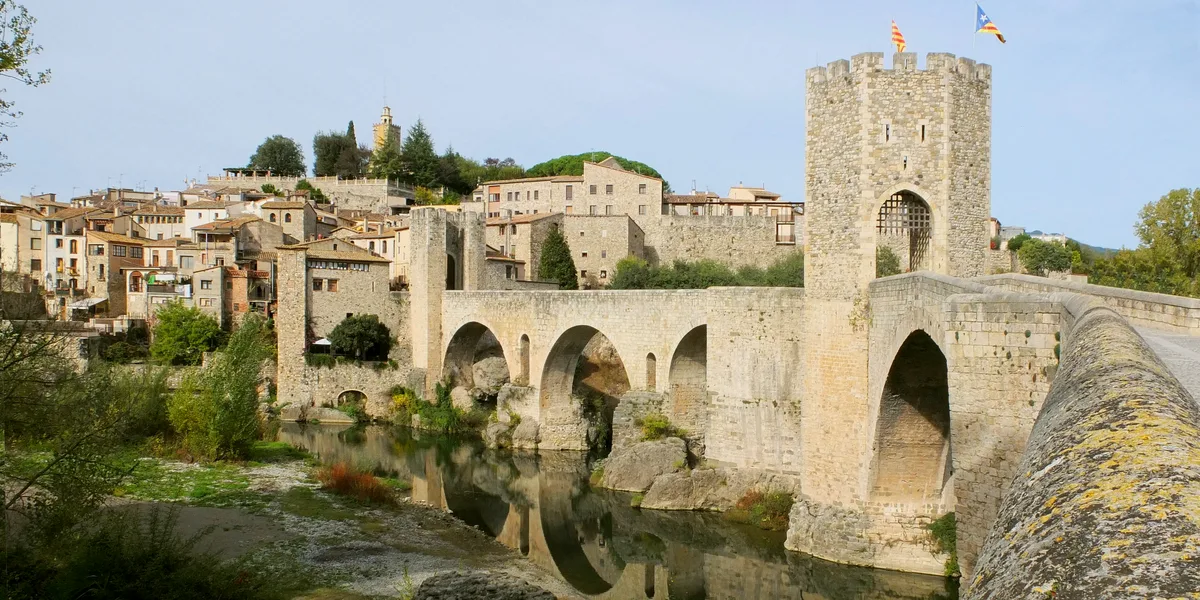
Besalú takes its name from Bisuldunum, meaning “fortress between two rivers”. The town was for over two centuries the capital of an independent county, and from that past it keeps a bridge built between the 12th and 14th centuries, a Benedictine monastery, its walled enclosure and the quarter where its Jewish community lived until 1436.
What to see
La Miqvé i Sinagoga de Besalú
A Jewish ritual bath from the Romanesque period, dating from the 12th century. A local resident came across it by chance under his house in December 1964, and it was the first of its kind found in Spain.
Pont Vell de Besalú
A Romanesque bridge from the 12th to 14th centuries, rebuilt time and again after floods and demolitions. Two of its arches were blown up in 1939, and its tower was rebuilt in 1965 following old engravings.
Castell Comtal de Besalú
Medieval castle from which Count Bernat Tallaferro ruled. Legend has it that a saint gave him a sword that could cut through iron.
Centre Històric de Besalú
The old town, Romanesque and dating from the 12th century. Besalú spent more than two centuries as capital of an independent county, with court, army and bishopric of its own.
Monestir de Sant Pere
A Benedictine monastery founded in 977 and consecrated in 1003. Its architecture combines 12th-century Romanesque work with Baroque elements.
Voltes de la Plaça de la Llibertat
Vernacular arcades on Plaça de la Llibertat. No two arches are alike: each house built its own at a different time, with no overall plan.
Plaça dels Jueus (Call Jueu de Besalú)
The quarter of Besalú's Jewish community, documented throughout the Middle Ages. The community left the town for good in 1436.
Iglesia parroquial de Sant Vicenç
A parish church with building phases from the 12th-13th, 14th and 17th centuries and a Romanesque and Gothic façade. It holds a relic whose story involves a theft, a fire and a Catalan patron.
Recinte Emmurallat de Besalú
Town walls raised between the 12th and 14th centuries. In 1285, with a French army besieging the town, the governor of Besalú set a trap for it that worked.
Carrer de Bernat Tallaferro
A 9th-10th-century street bearing the name of Count Bernat Tallaferro. He governed Besalú over a thousand years ago and, for a short time, made the town a bishop's seat.
Carrer del Portalet
A stepped street from the 9th-10th centuries. Its name recalls one of the smaller gates in the medieval wall, and it connects Plaça de la Llibertat to the area around the Cúria Reial and the call, the Jewish quarter.
Casa de la Vila
The town hall occupies this 17th-century building, set on top of the first two arches of the arcaded square. It used to house the Universitat de la Vila, the municipal government of the time.
How much time you need
With the Citourfy audio guide, the walk around Besalú takes about 1h 3min and covers 2.7 km. If you go inside museums or churches, add the time for each visit.
Getting to the starting point
- Starts right by Estación de autobuses de Besalú (TEISA, carretera d'Olot).
When to go: festivals
Local festivals, in case you want your visit to coincide with one:
- Besalú Medieval · August and September
On the last weekend of August the town turns into a medieval village, with a market, combat displays and street music.
- Festa Major de Besalú — Sant Prim i Sant Felicià · September
The town's main festival, dedicated to its patron saints Sant Prim and Sant Felicià: several days of events in the centre.
- Cavalcada de Reis · January
On 5 January the Three Kings parade crosses the Pont Vell and ends by greeting the children in the main square.
Besalú audio guide
The app narrates each place as soon as you arrive, using your phone's GPS:


Sources
The facts in this guide come from the same records as the audio guide and from these public inventories:
Facts checked on October 22, 2026.